
1
Landing Pages And The Urgency Of Time

2
Does Your Landing Page Need A Language Makeover?
3
Facebook CPC vs. Facebook CPM

Landing Pages And The Urgency Of Time

Landing Pages and The Urgency of Time?

This sounds like some kind of fucked up marketing ebook slash Harry Potter novel hybrid. But rest assured it’s not. It’s just the first title that came to my head. And seeing how I’ve been writing a “Beginners Guide” ebook for most of the weekend, I thought I’d go all J.K Rowling on the world.

If you’re new to CPA marketing:

1. Why are you reading this blog?
2. Will you buy my ebook?

It’ll be out in early December and it’ll teach you absolutely everything you need to know to start turning a profit in CPA marketing. Well actually, it won’t. But I’m not gonna tell you that when I’m actually selling it. Expect a Warrior Forum sized circle jerk of paid testimonials, artificial coupon price reductions and quite possibly Finch on his hands and knees. PLEASE YOU MOTHERFUCKING RETARD JUST BUY MY GOD DAMN BOOK THERE’S ONLY 47 RETARDS LEFT TO SELL IT TO.

Anyway, I got some positive feedback from the last post. Seems like there’s a demand for more landing page tips, so I’m going to address a technique that will nearly always increase your conversion rates.

It’s all about how to fuck a customer’s mind in to believing that there’s no better time than now for busting out the plastic and adding a swish $35 to your stats.

And I’ve pretty much just given the game away right there. It’s all about creating a sense of urgency in time.

Have you ever read a bunch of offer descriptions claiming that Product X has been “optimized, tried, tested, passed around, fobbed off and maximized” for the best conversion rates? What this basically means is that some dude took a look at their design and added a few calls-to-action that practically scream out to the user to order now or forever hold your peace. If you’ve engaged in some serious split testing in the past, you’ll be aware that one of the ultimate factors between success and failure is a sense of urgency in the consumer’s mind.

If you’ve got your eyes open, you should be seeing examples like this all the time:
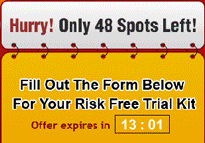
offer

How often do you see these rush-to-action techniques slapped on to merchant pages? It happens all the time with rebills. It works because the users are normally too dumb to think twice about challenging the deceitfulness of a JavaScript ticker. I’m not complaining, because that’s the way we like it.

So if we can accept that creating an urgency of time is key to increasing final conversion rates, why do so few marketers implement the same techniques to increase their clickthrough rates? This is a question that has always confused me.

Practically every variety of banner, text ad or Facebook flier I use is underlined by some kind of urgency to act now. Particularly when you step in to the realms of PPV and “interruption marketing”, it becomes even more important to stress the need to click and click now. Click now or you’ll miss out.

One of my favourite marketing techniques (but obviously not so precious to me that I’m going to keep it secret) is the 24 hour window sell. You might wonder what the hell that is, and rightly so, because I made the term up just then. But what I’m referring to is a landing page that was created “today” and will become redundant “tomorrow”.

Through the power of PHP, it’s really quite easy to add some dynamic controls to your page that edit the dates and create a realistic aura of “hot off the press”. I’m sure many affiliates are using this already to alter aspects of their landing pages. I’ve seen examples varying from the dates of comments, to the date of a post being published. But you’re really going to start to see the benefits if the date becomes an integral piece of your actual story.

I’m not going to out my own methods of doing that because it’s quite custom. But it’s all about creating relevance and urgency in one hit. If you can pair this up with a geographical scripting element, you should be golden for some mean looking conversion rates.

While basic PHP hacks are effective, you really need to be looking a little deeper in to your marketing efforts to see how time can be leveraged in other positive ways.

Taking a dieting product as an example, how could we build an urgency of time? How can we make Product X scream in the consumer’s face that it needs to be snapped up now? For dieting, it depends on the season.

Given how it’s nearly fucking Christmas already, you could try something like this:

“The acai berry is the world’s most in-demand superfood. But as we approach the new year, thousands of Americans will be looking to lose weight as part of their new years resolutions. Unfortunately we have to raise our prices during the peak season time. That means, you only have until [PHP SCRIPT INSERT] to start our revolutionary diet for a bargain $X.XX”

“You’ll still be able to buy Product X after that time. But unfortunately we can only sell it at the peak season price of [How cruel are you?]. This is still a fantastic deal for the body you’ve always dreamed of having, right? If you want to take advantage of our limited free supply, you must act now.”

“Save $XX.XX By Ordering Today! ACT NOW”

This is just another example, following on from the last post, of how you can turn a negative (the cost) in to a positive (what the customer is saving).

It’s also completely unverified considering 1) I don’t promote acai, and 2) I write this shit in about 20 minutes. But what I do know for sure is that time has, and continues to be, one of the biggest defining factors in whether I make a sale or not.

It’s worth taking a look at how your pages could be given the dynamic spark that brings them to life. Get creative in how you build an urgency to the consumer. There are so many innovative ways of doing so, and they don’t only have to be restricted to a landing page. Your banners, Facebook ads, sponsored search listings…they’re all fair game for a little mindfuck time-to-act-now makeover.

PS. If you’re new and don’t understand what just happened, buy my ebook in December. It’ll stimulate your mind AND offend you in one cool hit. A bit like a donkey punch, but with marketing attached.

Does Your Landing Page Need A Language Makeover?

This is a break away from the techniques that I normally write about. But in my mind, it’s probably one of the most important skills you can master in affiliate marketing. For all of the praise that top marketers get for their understanding of various demographics, not much attention is paid to the language that’s used to communicate with those demographics.

Every other day I get guys hitting me up with examples of landing pages they’ve put together. They normally ask me “do you think it will convert?”, “do you think I’m promoting to the right audience?”. More often than not the answer is a resounding and unfortunate no. It seems that a lot of affiliates – talented or otherwise – have trouble relaying to the user exactly why they should be persuaded to part with their credit cards.

You’ll find that the best converting landing pages generally excel when it comes to communicating on the correct level with their targeted demographics. And much of that communication boils down to good old fashioned persuasive writing. Writing with your market in mind.

Too many affiliates sell the features of a product instead of the benefits. It’s a classic mistake. I guarantee if you go back now and look at every landing page you’ve ever published, you’ll see glaring examples of the feature-sell that you missed at the time. We all fall victim to this, particularly those who churn out an obscene number of campaigns in the hope that something will stick. Understanding your market is key. You have to get aggressive and really attack the reader’s channel of thought.

As an example, here’s a snippet from an Acai flog I stumbled across the other day. This was supposed to be the “hard sell”. The slap in the face that gets Average Joe American to whip out his credit card in the hope of a looser waistband.

– No other fruit packs as many healthy vitamins, nutrients and antioxidants!
– The Acai Berry is only grown in the Amazons, which means our supplies are limited
– 1500mg per serving of 100% pure Acai Berry (it’s not filled with other useless chemicals)
– Eliminates harmful toxins in days!
– Free trial, only pay $2.95 for shipping

My problem with copy like this is simple. Why should I give a shit? Here is what your target market is thinking as he/she reads the key points.

– No other fruit packs as many healthy vitamins, nutrients and antioxidants!
Really? What’s an antioxidant? I don’t want a science lesson.

– The Acai Berry is only grown in the Amazons, which means our supplies are limited
I don’t give a shit about your supplies and I don’t give a shit about the Amazon rainforest. I care about my stretch marks.

– 1500mg per serving of 100% pure Acai Berry (it’s not filled with other useless chemicals)
What will 1500mg per serving do for me? Will it get me high? Will it clean my balls? Will it give me cancer?

– Eliminates harmful toxins in days!
Okay, cool I guess. I’ll remember not to take the damn thing in a gas chamber.

– Free trial, only pay $2.95 for shipping
Great. Sounds good value. Shame I won’t be buying it because I want something simple that miraculously cures my fat ass.

I’m not suggesting you start fabricating product benefits. But if you write your landing pages without the specific benefits of the product highlighted, you’re going to lose interest. It’s a classic case of an affiliate letting the product sell itself. You can get away with that for super high demand offers – but with a credit card submit on a skeptical consumer, you need to seal the deal. Here’s a simple modification to the copy above that makes it relevant.

– Full of healthy vitamins and nutrients that spur on healthy weight loss. Live a healthier life.
– Only in the Amazon. The Acai Berry is in extreme demand as the world’s number one weight loss superfood. Get it before it’s gone.
– 100% pure Acai. Don’t buy a weaker blend. Achieve maximum weight loss and boost your energy levels with the real deal.
– Start feeling the effects of a healthier body as our supplement flushes harmful toxins in DAYS.
– Want to feel better about yourself? Start shedding pounds today with the Acai Berry Diet for just $2.95 shipping

Each feature of the product is used to promote a benefit for the consumer. Now I’ve literally just translated this on the fly so don’t go jacking it in to your landing pages and then come running to me if it doesn’t convert. It’s the principle that you should be remembering. A good landing page will resonate a solution to a problem that the user has. If they don’t feel the explicit need to go out and purchase, they won’t. It’s up to you to sell that need.

I write my own content for most landing pages that I publish. I know a lot of guys choose to outsource – which I’ve done before – but I like to keep a close hold over the style of writing. Persuasive writing is something that I’ve always been strong at, even if I spent most of my English lessons through school sleeping or reading the paper. It’s a skill in itself. I don’t honestly expect all affiliate marketers to be good enough to handle the writing aspect of a good landing page. But what you definitely can do is narrow down the features and benefits of a given product. And you should be doing this before you even hit the Go button on your WordPress auto-install.

Draw up a checklist of the key product features. You should be able to jack the key points straight of the merchant page. Write them down and start brainstorming what sort of benefits each feature is going to provide. I like to do this before I choose my demographics to target. Primarily because it’s so easy to be ruled by the tide. Remember when 95% of Acai offers were targeted to females? Yeah, I wonder which bright spark decided that the key features of the acai offer could be just as easily translated to benefits for the male demographic…

Once I have my list of benefits, I like to turn in to a cynical piece of shit (some would say that’s what I always am), and begin to question them with possible consumer doubts.

The best landing pages don’t settle for simply describing the benefits of a product. They mercilessly stamp out the doubts and stumbling blocks that would prevent you from signing up.

My favourite way to do this in language form is to ask questions, and lots of them.

I can’t remember who said it, but it’s definitely true. The more times you can get a user to answer “YES!” to a question, the more likely it is that they’re going to say yes when it really matters.

Price is a regular doubt in the consumer’s mind. So I like to combat their doubts with questions that they can only really answer yes to.

For example:

“Wouldn’t you love to lose XXX pounds if you only had to pay $2.95 shipping? And with the option to cancel your free trial at any time?”

“Are you willing to pay just $2.95 shipping to try the weight loss superfood that could change your body and your life for the better? Can you afford $2.95 for the body you’ve always dreamed of having?”

It works because you’re tactically dealing with the consumer’s subconscious negative desire to shoot holes in your product, and forcing them to answer with a positive response. You can use positive language and positive questioning to very quickly break down the barriers that would have your target otherwise finding a reason not to buy. Price is very easy to address in the CPA world. Other issues are more challenging.

Writing to persuade is one of the great and rarely mentioned talents of top CPA marketers. If you’ve got it, you can sell in any environment. If you don’t have it, you should be looking to outsource to somebody who does.

Facebook CPC vs. Facebook CPM

One of the great stumbling blocks for newbie Facebook advertisers continues to be the knee-jerk reaction to bid CPC, CPC and only CPC. I’ll get briefly technical for those who don’t understand the terminology. It’s gonna be pretty centric to this post.

CPC is cost-per-click. You’re paying for every click that Facebook sends your way. It’s advantageous in that you’re never going to blow your budget on zero clicks. If you raise your bid high enough, you’re going to walk away with some test data even if you don’t profit. Unless of course you’re an absolute clustertard who doesn’t know how to get Facebook users to click on banners and eats impressions like they’re going out of fashion.

CPM is cost-per-mille. You’re bidding $X.XX for every 1000 impressions. If you don’t know what impressions are, seriously, give up and go home. The great advantage of CPM bidding is that, in theory, a good CTR (clickthrough rate) will see you paying a fraction of the cost for a click as you would with CPC bidding. This is because Facebook likes guaranteed money in the bank. For every 1000 page views on Facebook, your shit is being shown at the expense of another ad. If Facebook is getting paid to show it, regardless of the clicks, they couldn’t honestly care less whether your CTR is a 0.05 or a 0.15. But rest assured, YOU will care when a low CTR burns a hole in your pocket.

The overwhelming majority of new affiliates are so bat shit scared of their own ineptitude that the idea of bidding CPM is like jumping off a cliff in to a sea of fail. They will bid CPC because they like to be in control of their expenses. It’s much easier to calculate the metrics of what you need to do to be profitable if you’re working with a fixed CPC.

Unfortunately, I don’t think I would have ever made it as a Facebook affiliate if I’d only ever stuck to the CPC model. Practically every campaign I create, my intention is always the same – raise the god damn CTR and undercut Facebook’s tendency to bloat the price of a click to ridiculous proportians. That means getting on to CPM and producing a stellar creative that gets the users clicking.

I’m not going to dismiss CPC bidding strategies off the cuff. There’s a time and a place for them. But I am going to preach the importance of understanding how both of these strategies work – and how they can affect the performance of your campaigns.

Bidding with CPC

Not so long ago, it was possible for affiliates to bid CPC and rack up a ton of cheap clicks for as little as a few cents each. With traffic that converted and the volume that the world’s largest social networking site offered – it made a lot of affiliates very rich in a very short space of time. Unfortunately, an increase in advertising competition and a tighter ruling of what Facebook will allow hasn’t so much changed the game – it’s a started a new one.

You can still find cheap clicks in some markets. But if you’re thinking of hitting the United States with a sweeping demographic, you can expect the marketing challenge of a lifetime. Those cheap clicks are no more. You can either bid for the kids, or take your ass international and start hiring translators to tap in to markets that haven’t yet folded in on themselves. CPC bidding is still important though.

Calculated Testing with CPC

If you’re launching a new campaign and you have no educated idea of how the offer should be converting, it’s natural to want to get clicks through in a way that doesn’t burn your wallet. Likewise, if you know that the payout is $15, you can set your maximum CPC at $0.50 and know that as long as 1 in 30 of those clicks converts, you’re breaking even. The metrics are simple.

I like to run these initial CPC tests to gauge the conversion rate for my selected demographic on Facebook. Search PPC is not a good marker. The conversion rate will vary dramatically between traffic sources – especially if you’re direct linking.

If I found, for example, that I was breaking even with the 1/30 conversion rate – my attention would immediately turn to calculating what kind of CTR I would need to take the campaign on to CPM and lift my margins.

So with an EPC of $0.50, and my own personal preference being at least a 100% ROI, I would need to be paying no more than $0.25 per click. That then becomes my marker for a successful CPM campaign. If I can move to CPM and bid $0.25, I know that I need to be producing a CTR of 0.1 to be getting my 100% ROI.

It just so happens that a “suggested bid” CPC of $0.50 will usually translate to about $0.30 if you flick the CPM switch. This is why I generally suggest that you need to be hitting at least 0.1% with your CTRs to have much in the way of flexibility.

No Guarantee of Results with CPC

Everything I said above about calculated testing and CPC? Yeah, it doesn’t mean shit if your CTR stoops too low. I’ll say it again. Facebook likes money in the bank. If they give your ad 10,000 impressions and not a single user clicks – why would they continue to show it? Assuming there’s a CPM affiliate willing to pay $X.XX for the impressions whether anybody clicks or not?

So essentially, your CTR is still important. Bidding CPC to get a feel for your margins is all well and good, but you need to deliver a good creative. Or you’ll spend the rest of your life submitting ads to interns that take 6 days to get approved and run for about 7 minutes.

The way to conquer this common stumbling block is to leave absolutely no stone unturned with your split testing. Submit at least 10 ad variations, all significantly different, and this should be enough to force a decent ammount of impressions – and clicks – from Facebook to carve out some test data. No matter how retarded you are with your creatives, the law of numbers says that so much shit being thrown is going to leave something sticking on the wall.

What Scares Affiliates About CPM?

It took a little convincing for me to wade in to CPM advertising. I remember my fear being that an unsuccessful CPC campaign would waste my time – but rarely rinse my budget. An unsuccessful CPM campaign, however, would lose me money fast. I was worried that I’d spend money and nobody would even click my ad. Too many factors, too much weight on the creative…too much to worry about.

Are you serious about marketing though? The reality is that the large majority of networks and advertising agencies will require a CPM based media buy before they work with you – simply because it qualifies the affiliate. Why should they care that their traffic doesn’t back out for you? CPC is a gamble on their inventory, and I’m afraid to say, it’s nearly always the affiliate who’s left to roll the dice.

Facebook is probably the friendliest environment to get your feet wet with CPM. It’s self serve, which means that you can easily go in and switch off the campaigns that are leaking a loss. Remember this before you shit bricks when somebody tells you to break from your CPC patterns. Most affiliates are forced to adapt to CPM eventually, and they’re all the more diversified when they do.

CPM Bidding Delivers Value To Good Advertisers

Most people who fail through CPM bidding are victims of their own laziness and bad work. Cheap clicks for all are a thing of the past, but CPM makes it possible to cut the costs of your clicks quite dramatically. Remember that if you become chained to CPC bidding, you will always be restricted by the artificial ceiling of what Facebook decides to charge for that click.

If you take the CPM route, you’re still going to be somewhat exposed to Facebook’s charging variations – but a good CTR will ultimately decide the fate of your campaign. You can undercut Facebook’s valuation of a click and score cheap traffic by producing targeted advertisements. Good work from good affiliates will produce profit. That’s the difference maker.

Bidding CPM is the only way I’ve come close to replicating the cheap traffic that existed during the first months of Facebook Ads. Target your markets like a laser and there’s still big money to be made.

The Biggest Problem With CPM Bidding

And this is a big fucking problem, let me tell you. Facebook is inept when it comes to allowing the advertiser to implement day parting. That’s the ability to have your ad displayed only during specific intervals in the day.

There are tools and scripts to implement manual day-parting, and that’s the only reason I still use Facebook Ads because day parting is absolutely critical for any CPM campaign.

I’m not going to expose specific market trends, but needless to say, some offers convert a lot better and draw a lot more clicks during the night. If you’re bidding CPM, your exposure to slow periods in the day are that much more damaging. If you’re running CPC, you at least have the safety net of only paying for clicks. For some of my campaigns, however, the only way to stay profitable is to manually pause them during the hours that I’ve analyzed to be impression burners.

You want your traffic primed. CPM plus a lack of day parting is an ugly spanner in the works.

My word count is exploding so I’ve clearly gone off-track somewhere. This is a brief, but not too brief, look at the challenges of CPM and CPC. Hit me up with any questions. I’ve got a backlog of emails to reply to which were on this subject so I thought I’d summarize in to one ugly post. Will reply individually when I’m less busy playing with my balls.

Recommended This Week

  • Lots of Ads is the latest service to offer spying capabilities over Facebook’s most profitable ads. The great appeal for me is the ability to spy on International markets including France, Spain, Argentina, Brazil and many more. Save time on translations and tap in to the most lucrative markets on Facebook. Definitely a worthy addition to your toolkit. First 20 customers only who use code FINCH11 will receive 10% off their lifetime subscription. Enjoy!

  • If you’re a new reader, please add me to your RSS. Feel free to add Finch to your Facebook. Yes, this is the right link. My real name is not actually Finch. Also follow me on Twitter Love you long time. Thanks for reading.

Copyright © 2009-.